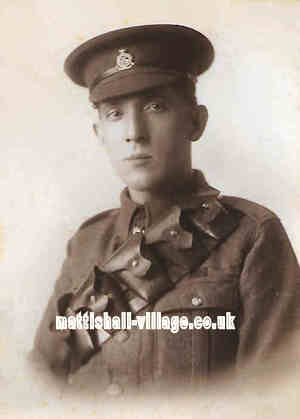
FRANK HENRY NORMAN WRIGHTON
1879 - 1917
Actor, Author, Dramatist Playwright, Poet &
Music Hall Artist.
Plus recruiter of men for the War Office.
Friday, November 2nd 1917 – My journey looking for First World War casualties had brought me to the picturesque seaside town of Torquay, Devon, many miles from the battle fields of the Western Front. A thin and wasted 38-year-old man had finally succumbed to an affliction he had acquired during his military service. Katherine Peacock, the Matron of St Barnabas Nursing Home for the Incurables, was recorded as being present. No records have been found to confirm there was any effort to return his remains to his home village of Mattishall Burgh, Norfolk although on his death certificate an address of 45 Warwick Road, Warwick Gardens, London was written, a large building where he or his wife could have been renting a room, whilst working in the capital. There was a war on and any transportation of a corpse would have involved considerable expense which from all accounts show there was little funds available. Four days later on November 6th he was taken the short trip to Torquay cemetery and after a simple service lowered into a common grave, a grave we now know he shares with four other men. His death was not the result of battle wounds but a condition brought on and worsened during his short military service. His death certificate, records him as ‘FRANK HENRY WRIGHTON’, age 38, an Actor. A simple note on his service records reads “He was well till a year ago, then had Pleurisy and Pneumonia, following wet exposure”. TB was also found in his Sputum. I had been researching this man for a few years and on discovering this I was left quite emotional. There was no record of him on the Commonwealth War Graves Commission website, even though the army had been paying and caring for him since his discharge. How had this man just been forgotten? I had got to know him well, my research had found he had been such a character, or being an actor, multiple characters! He was very patriotic, had a great spirit of determination and given a lot so ending up forgotten, in a common grave did not do him justice. My journey started with three small well-worn pieces of paper found in the personal effects of another First World War casualty from Mattishall, Private Sydney Marshall Cole, age 22. Cole was killed in France on March 19th 1917. The three pieces of paper contained ten verses of a hand written poem, the poem was about his home village of Mattishall and the surrounding Norfolk countryside. It was titled “An Anglers Ode to Norfolk & Country Life”. Holding the papers in my hands, I could not help but let my mind wander and imagine young Sydney crouched in a filthy water logged trench, probably utterly petrified. These young men had been thrown into what we now know was sheer utter hell on earth. It’s not hard to imagine in the quieter times Sydney taking the poem from his wallet and reading it through and through just to relive those warm memories of home. Were those words any comfort to young Sydney, we will never know but it must have transported his memories back to his safe, slow and peaceful life in Mattishall where he had left his family and friends. His heart must have ached with an incredible longing just to be home again. As we know Sydney never did return but his poem did, safely tucked in with his effects. The poem together with a picture of him taken with his younger brother in happier times has been treasured by his family for almost 100 years. The poem was signed “NORMAN WRIGHTON, His Majesty’s Theatre London S.W, Formerly of Mattishall Burgh.” - For MORE on Sydney Marshall Cole click HERE
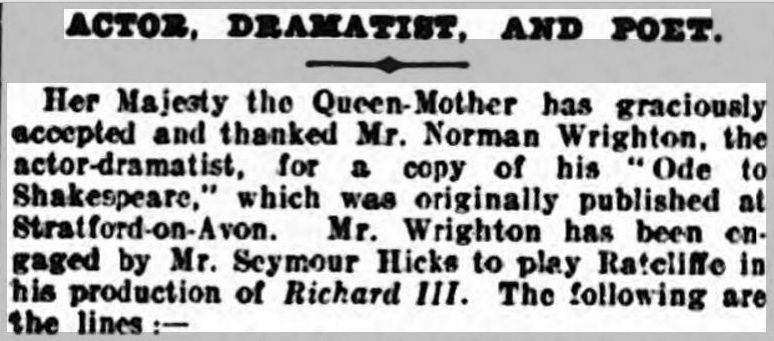
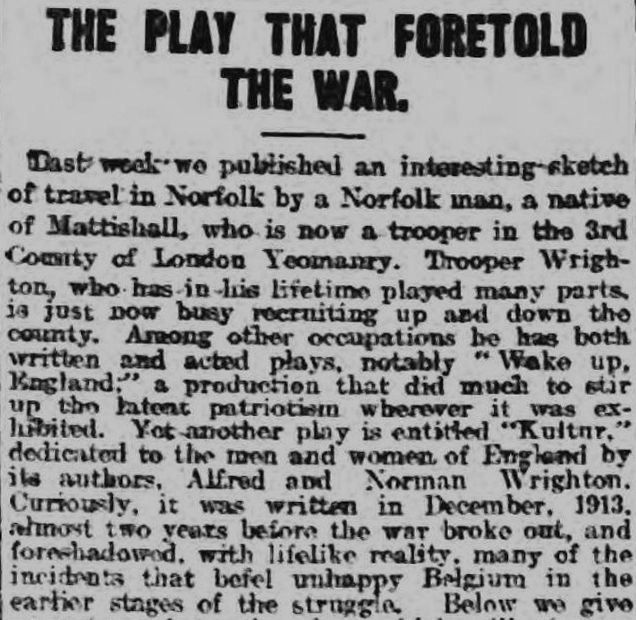
Who was this man? – I had taken all the names from the Mattishall War Memorial and one by one put together some form of personal family identity to show where they and their families fitted in to our local history. I wanted to show them more like people instead of just a surname with initials, something which should have been done much earlier for now virtually 100 years had passed and getting their stories from family members who knew them was no longer possible. What I did find were these young men were classed as heroes of their day and many of their pictures, medals and effects had been handed down respectfully through families as heirlooms. That is apart from NORMAN WRIGHTON. How did he know so much about Mattishall and Norfolk? Little by little information came up regarding his acting career but there was still no birth or death record. I did find him on the 1911 census living at a boarding-house in London. The census record stated he was married, his age given as 31 and his place of birth was Cannock in Staffordshire. It then dawned on me that NORMAN WRIGHTON was a stage name. NORMAN WRIGHTON – Shakespearean Actor, Author, poet and playwright. He played many small parts appearing in various plays in several London theatres. Some of the plays also took him to other parts of the country. In one he appeared with Lilly Langtree in 1905 in her play ‘As You Like It’. He was also an author writing ‘Wake Up England’ written about 1906 then converted to a shorter play called ‘Kultur’ about 1913, which foretold the First World War. The play centred in the small rural Norfolk village of Mattishall. The opening scene describes an invasion of German troops capturing the Maltings and Post Office, then the villagers taking refuge in the parish church of All Saints. It goes into detail the horrors the villagers were subjected to by the enemy. The play was performed, according to the papers of the time, up and down the country including the West End and Leeds, getting good reviews. Norman was never a huge star and often fell out of work. To get by, he was often seen busking and performing scenes from Shakespeare outside some of the top London theatres to the queues waiting for the doors to open. “What else could I do I had a wife to support” he said in an interview “sometimes I was performing seven acts per night” this he did in all weathers. He was even arrested for performing and delivering Shakespearean recitations in Hampton Court for what the policeman giving evidence to the court described as causing an obstruction for he had attracted a crowd of over 500 people, he was fined 1 shilling. There was also a dispute over copyright of his play but I could find no conclusion.
Norman was born ‘FRANK HENRY WRIGHTON’ on June 27th 1879, his birth was registered at Cannock Staffordshire, the son of Thomas Henry Garland Wrighton (1845) a Chemist and Dental Surgeon born in Dublin, Ireland, although not of Irish decent, and his wife Mary Jane Gayford Abbott, born May 14th 1852 in the Norfolk village of Shipdham. Little has been found in regards to Norman’s early life and schooling. We do know from census records he had two sisters May (1885), Kathleen (1889) and two brothers, Percy (1881) who died age 1 and Rowland (1890) all carried ‘Garland’ as their middle names. His mother was an Abbott, the daughter of Jonathan Abbott, a farmer of 174 acres, near the church of Shipdham, Norfolk. We can only assume this is where Norman’s love for the Norfolk countryside began while staying with his mother’s family. From his poetry, his heart was always for Norfolk and there is a two-week journal, also containing poetry of one of his visits travelling from village to village in a horse drawn caravan. He also claimed to have spent a year on a ranch in Canada but where his love for acting and Shakespeare, for which he was very knowledgeable came from is not known. On June 26th 1905 he married Winifred Bernice Norton at St Giles, London, a young girl from Mattishall Burgh. Winifred’s family (Norton’s) were a well-established Mattishall family of land owners and farmers. Mattishall is just a few miles from Shipdham. Winifred must have also had an interest in the theatre for it seems she made some appearances on stage alongside Norman.
Norman was a very patriotic man and by early 1914 it was becoming very clear war was on its way. Two events were mentioned in the Thetford and Watton Times where Norman, who at this time was representing the Navy League and had been very active reading his play and giving some impressive addresses to the villages of Mattishall and Hockering. When war broke out, he was among the first in line to enlist and did so on August 29th 1914. He had previously served in South Africa at the end of the Boer War as a Military Policeman but his enlistment this time was in the 3rd Country of London Yeomanry which was formed from South African veterans and then transferred to a Territorial Force. In accordance with the Territorial and Reserve Forces Act 1907 which brought the Territorial force into being, the unit was intended to be a home defence force for service during wartime and members could not be compelled to serve outside the country. From a financial perspective it also meant Norman was now receiving some kind of regular income
His enlistment gave Norman new energy and we find
he took on the role of recruitment. He was promoted to Acting
Sergeant (un-paid) on November 1st 1915 and was often seen on
Norwich market place and in London performing scenes from ‘Wake
Up England’ and ‘Kultur’ to attract and excite
recruits.
There was no official record found as to when Noman became ill but from his records he was subjected to wet exposure, it must have been very intensive for on May 29th 1916 he was reported as medically unfit for active service followed by his discharge a few days later on June 14th. He was granted a War Pension of 15 shillings a week, and then another application agreed to increase it to 27s and 6 pence per week. The Army sent him to a convalescent home on the Norfolk coast, near Cromer. During this time, he continued to show a positive attitude and said he would be back on stage by the autumn of 1916. It was during his hospital stay he wrote ‘CARRY ON!’ – A six verse Ballard of the Somme, dedicated to his friend, Lieutenant Nelson Ellis, Late British Expeditionary Force, France. Thanks to ‘David Whitehouse’
of Kent and Sharpshooter
Yeomanry for bringing this man my attention and for
his help with some of Nelson’s Military Records
However, things were not improving and he was transferred to a more specialist hospital in London. On January 31st 1917 Norman sent a short note to the ‘Era’ addressed from the Norfolk Ward, Albert Gallery, of the Brompton Hospital (specialist in heart and lung disease) simply saying “Am rather badly strafed.” From there he was sent to St. Barnabas’ Home for Incurables, Brocket Hall, Haldon Road, Torquay, Devon. St Barnabas was a T.B. home (one of many in Torquay) It was run by the same Order of Nuns as St Luke’s & St Raphael’s. Torquay was chosen as it was widely believed that the climate and clean air was a cure for TB. Sadly, Norman never recovered and died on November 2nd 1917.
There are scores of horrendous and heroic stories of young men, some still teenagers who in appalling circumstances, paid the ultimate sacrifice in what was to become the deadliest conflict in human history. FRANK HENRY NORMAN WRIGHTON contribution to the war effort could be said was less harrowing to what many went through, but never the less his early death was the result of an illness brought on whilst serving the country he so much loved. Who knows what he could have been had he lived on. The fact he was discharged, given a pension and placed in military hospitals confirmed the army had taken some sort of responsibility for him, but it was quite apparent after his death he had slipped under the radar, as it were, and had not been entered into the official war records. Norman played a key role in the War effort – His army service records show Mattishall Burgh as his home address – He showed great love for Norfolk and the village of Mattishall, this is well documented – Most important of all he is NOT listed on any War Memorial which is the next task. Ray Taylor
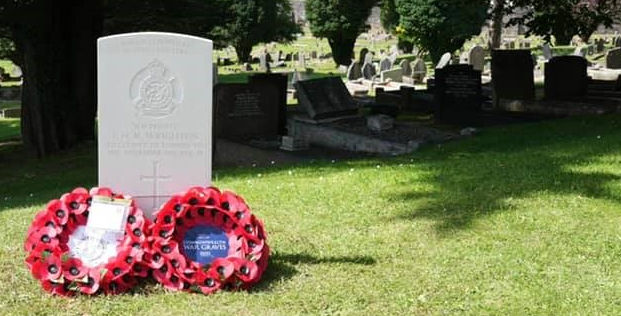
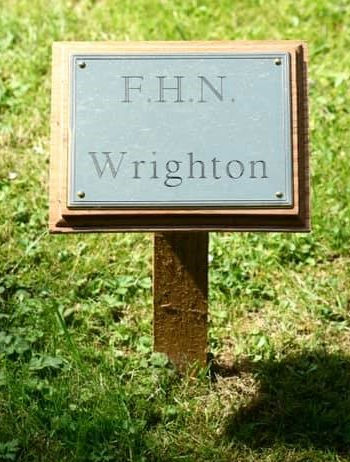
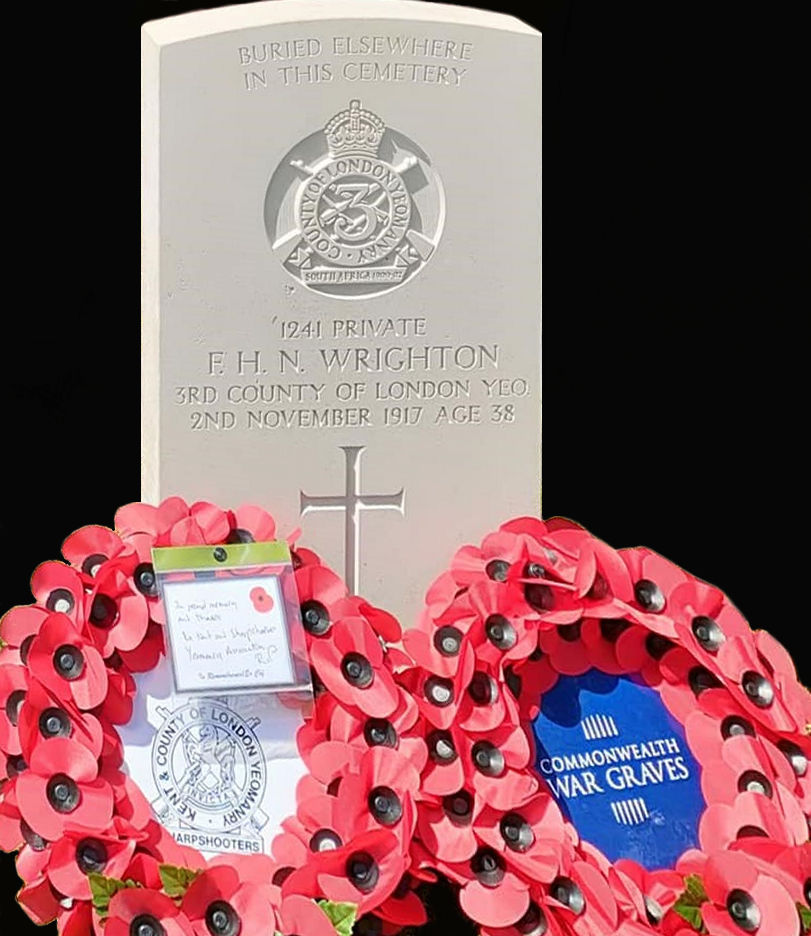
UpDate: The Commonwealth War Grave Commission have agreed to erect a ‘SPECIAL MEMORIAL’ to Frank Henry Norman Wrighton (who died as a result of an affliction caused by 'Wet-Exposure' whilst serving his country when England was at war with Germany) in Torquay cemetery - As Frank/Norman was buried in a communal grave with four others who are (probably) non-military the CWGC are not able to put a headstone on the grave itself - Where the location of a burial is not sure or where there is a mixed communal grave the CWGC erect a ‘Special memorial’ which usually states ‘believed to be buried in this cemetery’
DEDICATION
SERVICE
|






|
If
you are viewing this site through someone else's browser then
refresh here:- Site Address:- http://www.raytaylor.com |