QUEBEC HALL
East Dereham
| Parish Records and profiles of the' RASH' family (first owners of the Hall) have been moved to another page - click HERE for shortcut | Last up-dated -
23/08/2021 |
| If you share an interest in QUEBEC HALL, there are many documents at the Norfolk Records Office which could hold interesting facts and answers to questions - If you are ever at the Records Office and have some time to view any and would like to add anything to this page, I would be grateful of any help to achieve a fuller record - Details are listed below - quick link HERE |
| Email contact: Ray Taylor |
'Still under
construction' |
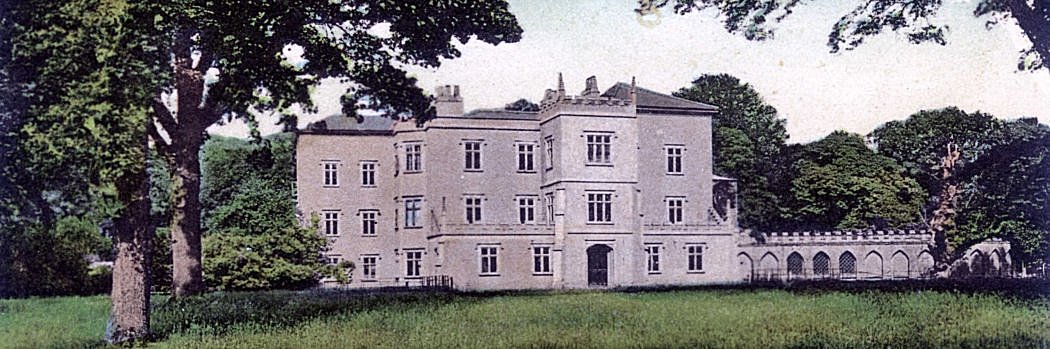
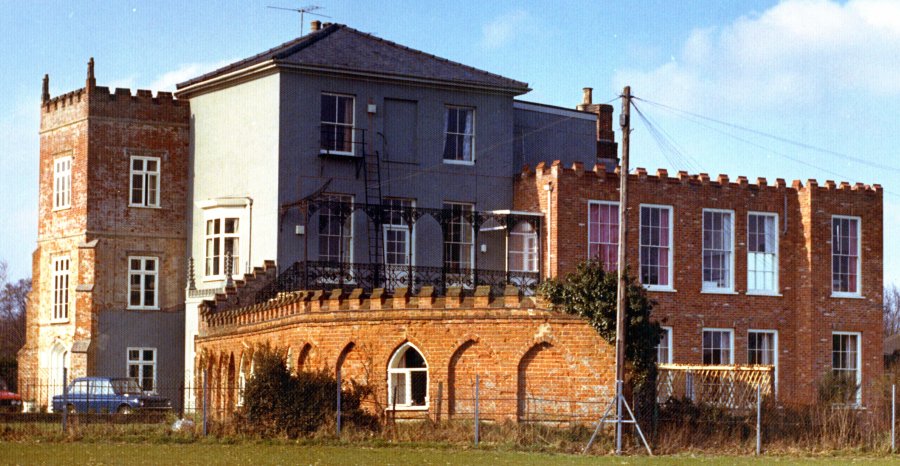
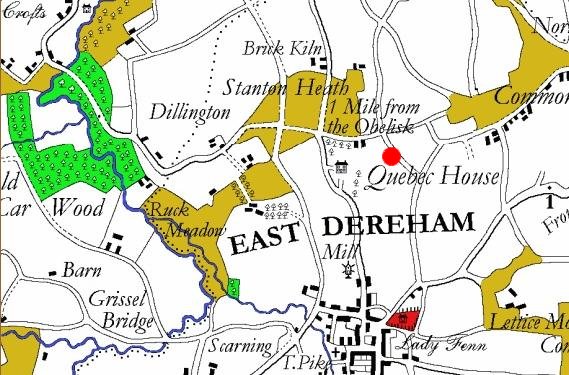
QUEBEC HALL was built on ground known in the 1700's as Stanten/Stanton Heath, previously used by the Militia volunteer’s as a camping ground. It is about half a mile from the town center of East Dereham, reached by the Dereham to North Elmham-road, also now known as the B1146. The main entrance then was by way of the Gate Houses, (built later in the early 1800's ), the entrance used today was added by David Potter in the late 1950's. The property actually started its life as a Public Inn called QUEBEC CASTLE. The original building did in fact resemble a 'Castle' as it's roof-line had parapets and battlements as seen below. The early property was said to have been built by Samuel Rash (born 1716) in about 1759, however an inn or public-house, or anything to do with brewing and or the selling of alcohol was quite foreign to his trade and profession as he was a successful and renowned local Attorney and Magistrate. The more likely is Thomas Rash (1688), Samuel's uncle, who actually did acquire a considerable fortune in Dereham as a brewer. However Thomas died in the June of 1760, so is it possible Samuel or Thomas's younger brother John (1701) inherited it and finished it off or tried to make it a going concern. However other stories go it was built by one of the 'Rash' family in or about 1759, albeit on a much lesser scale then we see it today. Much of the additions were added later by the Lee-Warner and Bulwer familys in the 1800's. It is not known, and no records have been found, to say if any member of the Rash family actually lived there ------ The question has to be asked, if it was Samuel who built it, WHY would he want to build an Inn. Could be that it was built as a hunting-lodge to entertain their friends and clients, as from all accounts the Rash's were all living in the town at the time. Whatever the reason it was short lived for in 1767 it appeared in the newspapers To-Let as a Public-Inn (details below). The story also goes the property, originally known as 'QUEBEC-CASTLE' was given its name in compliment to Brigadier General George Townshend who was engaged in the siege of Quebec, Canada which took place on September 13th 1759. It is known Samuel and George Townshend were well acquainted, for there are letters between them during Lords Townshends' electioneering plus, Townsend's home, 'Raynham Hal' is less then 15 mile from Dereham ---- Townshead was born on February 28th 1724, the son of Charles Townshend, 3rd Viscount Townshend and his wife Audrey Ethelreda Townshend (née Harrison). George Townshend was elected 'Member of Parliament' for Norfolk unopposed in 1747. He died at his family home, Raynham Hall in Norfolk on 14 September 1807 and was buried in the family vault there ---- There was another Thomas Rash (1700), who on the baptism of one of his children in 1740 had a note beside the entry of 'Captain', could he have been serving under Townshead and was there some patriotism to the man. He died in the June of 1759 at Dereham so we do known he was not at Quebec - More on the Rash Family HERE
1766: QUEBEC CASTLE was described in June 1766 as newly erected and in occupation of Alexander Kennedy - I can find nothing on this man! 1767: July 11th - Ipswich Journal
---- "To be LETT & Enter'd upon immediately. or at Michaemas
next.' ---- A PUBLIC INN call'd QUEBEC CASTLE, at EAST DEREHAM,
(the very centre of the County of Norfolk) consiting of a very
large Dining Room, several Chambers and Entertaining-Rooms, fitted
up in the neatest Manner, with very good Grainaries, Stable and
Barn, Also 16 Acres of Land surrounding it, in part planted for
a Garden and Nurseries - The House is new built in the GOTHIC
FORM, and so pleasently situated as to command a Prospect of near
twenty Miles of the most improved Part of Norfolk, and in that,
Views of near 40 differant Churches and Gentleman's Seats; particualy
Norwich Cathedral & Swaffham --- The Landlord will give all
possible Encouragement, and make further Conveniences to a Tenant,
and particuarly to a Person skilled in Gardening and Planting.
Enquire to Mr. Richard Leath at East Dereham, Mr. Crisp
of Shipdham, of Messrs, Chastney and * Thurston at their
Brewing Office in East Dereham or of Mr. Chastney at Trowse
or of Mr. Fare at Christ's Hospital, London."
1781: - The History and Antiquities
of the County of Norfolk: Launditch, Mitford ... 1790: May 8 - Norfolk Chronicle - TO BE SOLD - A Valuable and Compact Estate, in East Dereham, in Norfolk, consisting of a Messuage called QUEBEC CASTLE, with Coach-house, Barns, Stables and other offices, a good garden, orchard, plantations, and about 142 acres of very good arable and pasture land now in high cultivation. - The messuage and about 60 acres are now in the use of Charles Collyer Esq. and of which possession made be had at Michaelmas next. The remainder of the land is lett on lease, which expires at Michaelmas 1791. And to accommodate a purchaser who might not wish to purchase the whole estate, the house and any part of the land would be sold separately. For price and further particulars apply Mr Smyth, Attorney at Dereham.
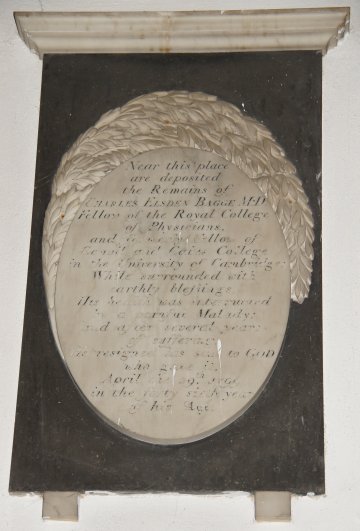
1798 + 1799: John Cary's book 'An Accurate Delineation of Great Britain' makes reference that QUEBEC CASTLE is occupied by C E Bagge - Charles Elsden Bagge, M.D., was the son of Rev Dr Bagge, of Lynn, Norfolk, school, Lynn for eight years under Mr Lloyd, then educated at Caius college, Cambridge, of which he was a fellow. He proceeded M.B. 1774; M.D. 1779; was admitted a Candidate of the College of Physicians 30th September, 1779; and a Fellow, 30th September, 1780. He married Anne daughter of Captian Thomas Lee-Warner on March 19th 1782 at Bale alias Bathley, Norfolk He practised for a short period in London, but then settled at Lynn Regis, where he remained some years, but eventually removed to East Dereham ----- The first record we have of Charles in Dereham is 1785 when he was witness to Samuel's daughter Sarah Penelope - Did he purchase QUEBEC HOUSE from the 1790 sale? --- From all accounts he was not a well man as can be seen in a memorial to him in St Nicholas church (below) ------ He died on April 29th 1799 age 45 and was buried on May 6th at St Nicholas Church where there are three memorials bearing his name-
We assume Charles died at QUEBEC HOUSE. - He left a Will which could be interesting. 1779: July 10th - Norfolk Chronicle - Further evidence of the name 'QUEBEC-CASTLE' is found in this newspaper when it was advertised again "To Let ----- 'QUEBEC-CASTLE', presently in the seat of Sir John Leeke, Baronet - the advert goes on to read "Particularly adapted for a 'Gentleman' who is partial to the Sports of the Field, has a Garden, Dove-Cote, and about 20 Acres of Arable and Pasture Land ---- in the same paper on Aug 07th - The elegant and complete Furniture, will be Sold by Auction by Richard Bacon on Monday 9th August, and the following day. The Goods can be viewed on the Thursday previous to the Day of Sale - The house may be view by applying to Mr Marston, Attorney at Dereham. The occupant above describes himself as Sir John Odingsells Leeke, Baronet, however his title was questionable. There is correspondence on record that the Leeke's family seat of Yaxley Hall, Suffolk were contesting it. In an article on the Leeke-Family we find the following: ------ I have in my possession a series of letters from him to the two successive owners of the Yaxley estate, Seymour and Francis Leeke. The fornier certainly most thoroughly believed in the descent he claimed, and did all he could to help him prove his right not only to the Baronetcy but the Earldom also. Sir John Odingsells Leeke, Bart, called himself a descendant of the Leekes, Earls of Scarsdale, he states he was a son of Robert Leeke, Rector of Great Snoring and Thursford in Norfolk, from 1734 to 1762. He held a subaltern's Commission in the West Norfolk Militia prior to the 'great revolutionary war'. He owned and resided at the mansion in East Dereham known' as QUEBEC, of which an engraving may be found in the 8th volume of Armstrong's History of Norfolk however his baronetcy was not universally acknowledged. In a letter written by Sir Henry Hunloke, of Wringeworth, on January 26th, 1786, he says, " I wish your friend Sir John Leeke success, if he could gain so old an Earldom it would be great indeed, but the Baronettage would be better than loosing, all. Your Ancestors were among the first made Baronets at the institution." Later on the poor gentleman fell on cruel times, and his pleading letters are quite painful to read. He describes himself as " a martyr to misfortune." Mr.Tallack, one of the correspondents in the East Anglian, says, " He must have come down very considerably in the social scale, for at the time of his death he was hostler (employed to look after horses) at the Old Lobster Inn, Norwich, and his wife was a washerwoman. I have heard persons who remembered them say that although in such humble positions', they bore unmistakable signs of having once belonged to refined society." In the early part of the next century he raised money on his reversionary interest in the Yaxley Hall estate; for Francis Leeke was still unmarried, and though Elizabeth Christian Leeke had married a Captain Bligh, there was no issue of the marriage, and at length he sold it to a Mr Whally. The last record of him may still be seen on a small gravestone in the churchyard of St. Stephen's, Norwich where he was buried on Feb 9th 1816, " Beneath are deposited the remains of Sir John Odingsells Leeke, Bart, who departed this life, February 5th 1816, aged 69, and of his relict Lady Leeke, who died, October 13th 1818, aged 80 years." ----- On a search of records it does in fact show John Odingsells Leeke was the son of Robert Leeke, Rector of Great Snoring and Sarah his wife, he was baptised on July 3rd 1747. at St Mary's Church.
This was found in the National Archives in a Volume
of "The Complete Baronetage" A point in Dereham's history 1802-10: Several other entries were still being printed in travel/information books of the Dereham area refering to the 'INN' called QUEBEC-CASTLE by this time owned or occupied by St Andrew St John." 1803: - 'QUEBEC HOUSE' was again occupied by St Andrew St John. --- So who was this man? - I though with such an unusual name he would be easy to find. One man that could fit in is St Andrew St John (1766- 1836) who was a Doctor of Civil Law, at his death in 1836 he was at his property at Gayton, Norfolk which he had had built about 1800 as a shooting box. The house has an irregular plan and was built in several stages. It was not unusual at this time for the wealthy to own properties and rent them out so this could be our man - however I am not sure. 1808: - QUEBEC HOUSE in local directories still recorded St Andrew St John as owner - However it has to be said these books were often out of date ----- It could be that the property had in fact changed hands back to the Bagge family in or about this time as the following newspaper article is found. 1808: - June 15th - Bury and Norwich Post - the article makes mention to a death at 'QUEBEC HOUSE' ---- It was of Henry Lee-Bagge Esq, age 25, after only a few hours of illness, however there was no mention as to if he was living there or visiting ----- Henry was the eldest son of Charles Elsden Bagge, the doctor of medicine mention above and the Halls occupant in 1799. Charles's wife, Anne Lee-Warner, was the only daughter of Captain Thomas Lee-Warner, who was a Peer of the Realm --- Charles's widow formerly Anne Lee-Warner remarried to her husband's cousin Thomas Bagge but they had no children, so a partition was made to the King to have the peerage passed to the four sons she had by Charles, A Royal Warrant was granted William Wilson Bagge (1785), became William Wilson Lee-Warner, he also became the future owner of QUEBEC HALL. Details of the case was printed in many of the newspapers of the time as seen below:
Charles's son William Wilson Lee-Warner
now marries
1832: In the December of 1832 there was a large timber sale advertised in the paper. This was followed in the September of 1835 when a large barley-stack was fired and totally destroyed by diabolical hands of an incendiary; but happily, through the prompt exertions of the neighborhood, no further damage was sustained ----- A record in 1836 mentions that QUEBEC-HOUSE although originally small has been enlarged at various periods, and is now an extensive and beautiful Gothic mansion, with a verdant park and tastefully laid-out pleasure grounds. There are several newspaper articles on the social activities that went on at 'QUEBEC HALL' given by William and Mary Anne, where they entertain many well know people as well as the local townsfolk of Dereham. Another article in January 1844 reads William Wilson Lee-Warner has given a munificent donation of 80 volumes to the library. Then in April 1847 one gives mention that William and Mary left their home in Dereham for Paris. 1836: Aug 6 - Norfolk Chronicle
- Robert Fitt, aged 33, pleaded guilty to having stolen
one ram, the property of W W Lee-Warner Esq. of QUEBEC
HOUSE, East Dereham - Robert Fitt was connvicted
at Norfolk Assizes for a term of life on 02 August 1836 - He departed
England on the ship Mangles together with 309 other convicts on
March 18th 1837 for New South Wales and arrived on July 10th 1837.
William Lee-Warner was
a member of the Dereham Railway committee 1850: In this year the Reverend Benjamin John Armstrong arrived in East Dereham. He took up the position as the new Vicar of St Nicholas Church, in the center of the town. Benjamin Armstrong would hold this position for 38 years. During this time he kept a diary. Thankfully after his death the collection of books were saved and passed down through his family. Recognising the importance of these everyday accounts of Victorian life, his Grandson transcribed and published some of them in a book titled "A Norfolk Diary". To this date (2019) yet two further publications have been published - Several of the entries make mention to QUEBEC HALL and it occupants. Below are some of those extracts giving some insight of what life was like at QUEBEC HALL during this period.
1852: - On Monday June 14th, at 61 Welbeck Street, Cavendish-square, London William Wilson Lee-Warner died. ----- Norfolk News June 19th , reads "Died on Monday last at 61 Welbech Street, Cavendish Square, London. William Wilson Lee-Warner Esq, of QUEBEC HALL, East Dereham, Norfolk. Foremost in work of charity and mercy, his helping had was ever ready when the necessities of his poorer brethren require it; an active magistrate, and a kind master, his loss will be long and deeply felt in the locality in which he lived, in whose welfare he took a lively interest, and whose steadily increasing prosperity was to him a source of constant enjoyment in the calm evening of his life." 1852: June 16 - Intelligence reached Dereham of the decease, in London, of W. W. Lee Warner, Esq., our local magistrate and squire. Mr Lee Warner was buried on June 22nd, eight of the neighbouring clergy and gentry being his pall-bearers. A vast crowd filled the church. – from Revd Benjamin Armstrong’s diary (Rector of East Dereham) William's wife Mary Anne continued to live at 'QUEBEC-HALL' and in 1855 the Rev Benjamin Armstrong records in his diary, that when having dinner with her at the Hall told him the following "Mrs Lee-Warner when Miss Dering and living with her father in the Fen district, riots broke out after the late war in consequence of the price of grain. So serious were they that the houses of magistrates were burned. No less that nine men suffered the extreme penalty of the Law a Ely for crimes connected with the outbreak. Mr Dering, as a magistrate, was of course a marked man. It was known that, while he was away from home his house was to be attacked. But how to get the news to him was the difficulty. The men could not be spared and the women dared not go. On this the spirited Miss Dering disguised herself as a gipsy and got to her father and the premises were saved." 1853: December 2 - Dined at Mrs Lee Warner's for the first time since the death of the Squire, & sat in the place of the host. There were present the Hon. Mr Harbord, brother to Lord Suffield, & reputed to be the handsomest man in the Eastern Counties, Mr & Mrs Dashwood, (sister to Lord Hastings), Mr Maugham of Stretton & the Lee Warners of Walsingham Abbey. Mr Dashwood told the story of a visit of the Dukes of Sussex & Cambridge to Holkham. When shooting, notwithstanding game was most abundant, one of the Dukes did not touch a feather. The keeper, however, who was also shooting, floored them right & left, and continually ascribed the success to the Duke, saying 'Your Royal Highness' bird'. At last old Mr Coke lost all patience, & running up to the keeper, administered a kick in his rear, saying, 'you are a lying humbug, he hasn't killed one, and you know it'. – from Revd Benjamin Armstrong’s diary (Rector of East Dereham) 1854: Francis White's History, Gazetteer and Directory of Norfolk 1854 - QUEBEC HOUSE, ¾ of a mile N. of the town, was built by the late Mr. Rash, who gave it the name it bears in compliment to Lord Townshend, who was second in command at the seige of Quebec. It is a handsome Gothic mansion, with a delightful park and tasteful pleasure grounds, and is now the seat of Mrs. Lee-Warner. 1854: February 8 - Dined at the Lee Warner's where one is sure to meet first-rate people. The Keppels, the Gurdons, Mr Pratt, Mr Haggard etc were there. I must say, however, that the conversation of the Squirearchy, though no longer exceptionable, as in days of yore, is not superior to those smaller fry, the 'professionals' & small gentry. They were laughing, good-naturedly enough, at the Times often speaking of the 'Booby Country Squires'. Although I am always on the qui vive to learn something, I gleaned nothing on this occasion beyond the satisfactory statement of Mr Gurdon, who said that, when he first frequented `Brookes', they used to be playing cards all day, as well as half the night, at 30£ the rubber which was not considered high. Now there is very little playing seen in the evening, & that restricted to 10/6 points, High enough too! – from Revd Benjamin Armstrong’s diary (Rector of East Dereham) 1854: November 13 - Dined at QUEBEC [House — the home of the Lee Warners] to meet another gay party who are staying there. Among them were Capt., Mrs & Miss Fitzroy, Rev. Burney of Hockering, Mr & Mrs Marsham. Capt. F. told a story connected with the present war, which proves that chivalry is not extinct. An officer in the Guards had arranged with his senior to purchase his commission. All was agreed upon, but as the vendor was on his way to sign the necessary papers he met a friend who informed him that war was declared with Austria. To sell out under such circumstances was out of the question. The negotiation therefore went off, but, said the senior to the junior, 'We shall go out, & perhaps you may get your promotion without purchase'. This actually occurred, the Senior was killed & the Junior succeeded him as matter of right, but he sent to the widow the sum of money which had been originally agreed upon as the price of the Commission. This was noble conduct on both sides! How different from the jobbing & distrustful method in which those sort of transactions are sometimes managed! – from Revd Benjamin Armstrong’s diary (Rector of East Dereham) 1854: January 2 - Dined at Quebec, & took Miss Astley, sister to Lord Hastings, to dinner. That lady very agreeable, & amusing on the subject of `Catholics' & 'Protestants' as she called them. Told the story of a nephew of the Duke of Norfolk leaving the Life Guards to turn Roman Priest, at the instigation of Cardinal Wiseman. Described him as young, handsome, wealthy & agreeable. Had she not been an old spinster should have begun to suspect she had a penchant for him herself. – from Revd Benjamin Armstrong’s diary (Rector of East Dereham) 1854: November 30 - An excellent attendance at the service. Glad to see the Lee Warners there as setting a good example. Miss L.W. told us afterwards the story of the beautiful Mrs Ives I lately met at Quebec. She was the daughter of a small builder in Norwich, & when about 16 years old, was seen by Capt. Ives, a person of property & station, in great distress at the loss of her dog. The Capt. gallantly got off his horse, & set the matter right. Was captivated, sent her to school, married her, & never regretted doing so! – from Revd Benjamin Armstrong’s diary (Rector of East Dereham) 1855: March 14 - After mattins our heiress, Miss Lee Warner came into the vestry with a lovely bunch of violets and a very knowing face. She had something very particular to tell and was determined that I should know it only from herself - giving me the violets. "You are engaged to be married," I said. And such turned out to be the case. The happy man is Captain Bulwer who has a slight wound in his arm and has lately returned from the Crimea. – from Revd Benjamin Armstrong’s diary (Rector of East Dereham) 1855: April 13 - Capt. Bulwer said he had received a letter from the French Embassy today, in which it is said, that the Embassy had received an anonymous letter to the effect that the Emperor Napoleon. III would be fired at, at Charing Cross, during his visit to the Queen next week. This would be the deed of some Frenchman, the Emperor being at this time highly popular in England, not only because success has, so far, attended his grasp at the throne, but on account of the energy with which he carries on the war with Russia. It is singular that he should have once predicted of himself, that his end would be assassination in the Strand! – from Revd Benjamin Armstrong’s diary (Rector of East Dereham) 1855: - July 5 - The Revd Benjamin Armstrong was quite a figure in the town by this time and today, renowned for his diaries of life in those timesOn this day he assisted in the marriage of Mary Anne Dering Lee-Warner the daughter of the late William Wilson Lee-Warner to Captain William Earle Gascoyne Bulwer, Gentleman, son of William Earle Lytton Bulwer Esq. The following appeared in the Norfolk Chronicle: ------ A day which will long be remembered in Dereham, being the wedding of our young `Squireen' Miss Lee Warner to Capt. Bulwer. I had the church decorated with wreaths of flowers made by the schoolchildren & disposed by myself. The Church was absolutely crammed with people, many of whom had come in from the neighbouring villages on the occasion of the fair. The numerous bridesmaids with pink & white, & others with blue & white made a goodly show, & the effect was good, when headed by the two officiating priests Mr Dashwood of Stow Bardolph, (the bride' guardian) & myself, the train moved from the Vestry and the organ burst forth. The school children were ranged along the church path scattering flowers, headed by my darlings, Helen & Louisa, who performed their part very well. The Luncheon & the Speech-making were as usual, and at an early hour the happy pair drove off for Lincolnshire, en route to Scotland. In the afternoon went up again and presided at the banquet to the poor. It is gratifying to observe that the poor were not forgotten, about 50 of them partaking of good old English fare under a tent on the grounds, and testifying by many a kind wish and hearty cheer their respectful sympathy on so interesting and gratifying an occasion. Came home hoarse with shouting and poisoned with Tobacco smoke. Thus I have lost a charming, interesting and well-disposed parishioner, and one whose happy forte it was, by an unconscious kind of tact to accommodate herself to those inequalities of condition always to be met with in country towns. She has every qualification, I am sure, to make her husband happy.The couple, from now made QUEBEC HALL their home. – from Revd Benjamin Armstrong’s diary (Rector of East Dereham)
1856: June
27 - My father accompanied me to a luncheon-dinner at " QUEBEC"
with Capt. and Mrs Bulwer. We met a certain Mr Bellairs,
who had been a midshipman at Trafalgar, a captain at Waterloo,
a banker, the proprietor of a silk mill, and finally a clergyman.
Such a thing could not be now when bishops will not ordain if
you have been anything except a medical man, and not always then.
– from Revd Benjamin Armstrong’s
diary (Rector of East Dereham) 1857: September
8 - A soaking wet day. To the School, where announced Mrs Lee
Warner's intention of giving a feast to the children, &
also took the names of all the truants and renegades with a view
to inducing their parents to send them back. –
from Revd Benjamin Armstrong’s diary (Rector of East
Dereham)
1857: September 29 - At 1, the schoolchildren, 325 in number, with their teachers, marched in procession from the School House, with Banners, & preceded by music, through the Market Place and up to QUEBEC, the wagon with the children from Etling Green bringing up the rear. Many of the parishioners living on the route hung out flags, in token of good will, which drew forth rounds of applause from the boys. At QUEBEC, a select company was in the garden, and as the rustic procession wound through the trees, their appearance was very effective. All sorts of games were provided, and a liberal repast of tea, cake, bread & butter etc., to which they did ample justice. They did not depart till moonlight, & the shouting was heard on their arriving in the town, though nearly a mile from the scene of pleasure. This treat is very opportune as coming just as we are attempting a School revival under the management of the new master & mistress. – from Revd Benjamin Armstrong’s diary (Rector of East Dereham) 1858: February 10 - Dereham. Went to QUEBEC HOUSE for luncheon. Captain and Mrs. Bulwer were there and several visitors. I was struck as I have often been before, with the said idling of time in these country reunions. People have no right to twaddle a precious morning away at bagatelle or in insipid and profitless conversation. Abominably stupid such gatherings must be. Felt the oppression even for my two hours and was glad to get away and have an afternoon among the sick, as they were just beginning to debate whether or not the weather was fitting for a drive. – from Revd Benjamin Armstrong’s diary (Rector of East Dereham) 1858: September 4 - Mrs Lee Warner died, after an illness of only 3 or 4 days. She caught cold while working in the garden, sore throat set in & terminated fatally. She will not be very much missed as a supporter of local charities, but she was always a lady, behaving kindly to all & regularly attending Sunday services in all weathers. She died in her 71st year. – from Revd Benjamin Armstrong’s diary (Rector of East Dereham) 1858: Oct 23 - Probate - Mary Anne Lee-Warner, late of QUEBEC HOUSE of the parish of East Dereham in the county of Norfolk, widow deceased who died Septembet 4th 1858 at QUEBEC HOUSE aforsaid were granted at the Prinicpal Registry to Mary Anne Dering Bulwer (Wife of William Earle Gascoyne Lytton Bulwer of Garboldisham in the said county) the only child of the said Deceased - Effects under £6000.00 1860: March 17 - Called at QUEBEC HALL to inquire for Mrs. Bulwer who is confined of a little girl (Sybil). The captain showed us his pictures of which he has a good collection. – from Revd Benjamin Armstrong’s diary (Rector of East Dereham) 1860: December 2 - After service, to QUEBEC to be introduced to the wife of Capt. Caldwell, of H.M.S. 'Mersey*'. This vessel in which my nephew & godson is a 'middy' has been ordered to the West Indies for 3 years, as his parents feared, but I now learn it is only for as many months. My object in seeing Mrs C. was to further the boy's interests. He is so deaf that it is feared by the Captain that he must leave the service, but I hope to have secured that such shall not be done without positive necessity. – from Revd Benjamin Armstrong’s diary (Rector of East Dereham)
1861: - Now after one-hundred years the Hall was now a sustainable property. In the 1861 census William and Mary Ann known as Marian had two children, a son, William Dering Earl, born 1856, and Sybil Dering, born 1860. In their employ was a butler/footman, cook, nurse, nursemaid, housemaid and kitchen maid. William and Marian had further children, Marain Dering, born 1863 and Edward Augustine Earle, born 1864. Sadly Sybil died at home in the Hall, she was in her 8th year, her young body was laid to rest at Heydon churchyard (the Historical Bulwer family Seat) on December 21st 1867 ------- William (late Lieut. and Capt. Scotch Fusilier Guards) was elected captain of the 15th East Dereham Rifle Club & Volunteers Rifle Corps on February 7th 1861 and from then many meeting were held in the grounds of the Hall. 1861: December 11 - My wife, Helen & I dined at QUEBEC. Among the party staying for the Ball is Major Bedingfield, son of Sir Henry Bedingfield — one of the oldest families in Norfolk. Their place is Oxburgh, a fine old moated mansion towards Lynn. An ancestor of his, it was, who held the Princess Elizabeth, afterward Queen, in durance vile, & who proclaimed Mary Queen, at Norwich. They are still staunch Romanists. He is a very handsome young man, & in the Norfolk Artillery. – from Revd Benjamin Armstrong’s diary (Rector of East Dereham) 1863: October 9 - Dined at QUEBEC HOUSE and met, among others, Sir Guy and Lady Nugent. Sir Guy said that he was a pupil of Bishop Blomfield when he was Rector of Chesterfield and that his irritability was so great that he would scold the pupils roundly and then, in an hour's time, beg their pardon! – from Revd Benjamin Armstrong’s diary (Rector of East Dereham) 1864: February 11 - The whole day employed in going round to the 18 District Visitors, accompanied by the Churchwarden, selecting proper persons for Mrs Lee Warner's gift of coals. – from Revd Benjamin Armstrong’s diary (Rector of East Dereham) 1869: - February 9th - Rev George Henry Dashwood, was a house guest of William and Mary Anne's, who during his stay, after suffering a few days illness, died at QUEBEC HOUSE. He was a British Antiquary and was a renowned and respected fellow of the Society of Antiquaries and published numerous works, including many articles for the Norfolk and Norwich Archaeological Society. He was born on October 21st 1800, at Downham Market, the son of the Revd James Dashwood --- George became curate at Stow Bardolph in 1840; being appointed to the living of the parish combined with Wimbotsham by Sir Thomas Hare in 1853. George married Marianne Job, formerly Turner a widow, on October 14th 1830 at Kirkby Laythorpe, Lincolnshire. Marianne was the daughter of W. H. Turner, and widow of Dr Henry Job of the 13th Light Dragoons. George was buried on 16 February, aged 68, next to his wife Marianne, who had died in 1855, in Stow Bardolph church - they had no children.
1876: July 14 - Dined at QUEBEC today to meet Mr Price, Recorder of York, and Judge of our County Court. Rather a bumptious little gentleman, who prides himself on 'knowing everybody'. – from Revd Benjamin Armstrong’s diary (Rector of East Dereham) 1877: - Another tragedy concerning and infant struck the Hall, this time in the September of 1877, Mary Jane Weston age 23, a single women who was in the employ of Captain Bulwer was alleged to have concealed the birth and death of her female infant. The inquest was opened at The King's Head Hotel in the town where Mrs Elizabeth Barnes, wife of John, the gardener was examined by the Coroner, she said: I went to her bedroom and said "Mary what's up" she said "I don't know" I formed the opinion that she had been recently delivered of a child. I said "Mary what have you done with your baby?" She said "It is in that box." She then pointed to a wooden cloths box by the bedside. The box was locked and the keys in her possession, and she gave them to me. I unlocked the box but did not open it until Mr Hastings (surgeon) came. When he came I opened it, and found it contained the dead body of a newly-born female child. Mr Hastings carried out a though post-mortum and after delivering his findings the jury found that there was not sufficient evidence to show that the child was born alive. 1878: September 23 - Dined at QUEBEC & met General & Mrs Bulwer, General & Mrs Lennox. Conversation about Afghan War which seems to be inevitable as the Amir has refused to let our military mission enter his state. What added interest to this was that Lord Lytton, Governor of India, is uncle to the Bulwers, and is said to have occasioned the situation by mismanagement. Who knows? – from Revd Benjamin Armstrong’s diary (Rector of East Dereham) 1879: October 1 - Dined at the Bulwers and met a South African settlers' party. They seemed to think that the capture of Cetawayo — recently effected — and the war itself, was an absolute necessity as the colony of Natal was at his mercy, and if he had followed up his victory over us at Isandlwana, he might have taken possession, in which case every white would have been murdered. There was an African tinge over the party, the Bulwers having a son with Sir H. Bulwer, Governor of Natal, and the Collisons having a son in the wine trade there, and who diversifies business with elephant shooting and other big game. Curiously enough we are asked to meet Sir Theophilus Shepstone* in a day or so, to whose policy the war is attributable. – from Revd Benjamin Armstrong’s diary (Rector of East Dereham)
1881: January
14 - Dined with some of my family at " QUEBEC" to meet
Dr and Mrs Jessop. We ate swan. The Doctor told us a story
of Mr Jex Blake, a Norfolk squire with a wooden leg, and
whom we met at dinner at Belaugh in the autumn, who had his leg
smashed by a cannon shot at Waterloo. He was humanely treated
by a staff officer on the field. He never knew who his benefactor
was till he met him accidentally at a dinner party a year ago.
The story of "the poor-boy with the smashed leg" was
told by the benefactor himself. "And I," said Mr
Jex Blake, "was the boy." They are both now very
old men, but neither of them had forgotten. – from Revd
Benjamin Armstrong’s diary (Rector of East Dereham)
1881: - was not a good year for Colonial and Mrs Bulwer. On a trip to Norwich in February, Mrs Mary Anne, narrowly escaped injury, when the hansom cab she was traveling in down Guildhall Hill, the shafts broke off bringing the horse down on it haunches against the Omnibus Shelter. The animal seemed inclined to be restive, but thanks to the timely assistance of cabmen standing near, and others Mary Anne was safely removed from her dangerous position. Then in the June, Colonel Bulwer, met with a serious accident which prevented his appearance in public for some time. It is reported that he was engaged in a game of lawn tennis with some young friends, when he slipped, snapping the tendons in his leg. 1881: - January 14 - From Rev Benjamin Armstrong's Diary - Dined with some of my family at 'QUEBEC HOUSE' to meet Dr. and Mrs Jessop. We ate swan. The Doctor told us a story of Mr. Jex Blake, a Norfolk squire with a wooden leg, and whom we met at dinner at Belaugh Hall in the autumn, who had his leg smashed by a cannon shot at Waterloo. He was humanely treated by a staff officer on the field. He never knew who his benefactor was till he met him accidentally at a dinner party a year ago. The story of 'the poor boy with the smashed leg' was told by the benefactor himself. "And I", said Mr Jex Blake "was the boy". They are both now very old men, but neither of them had forgotten. 1881: - January 23 - Another few lines from Rev Benjamin Armstrong's Diary - Driving in a sleigh to Hoe for the afternoon service, I found a snowdrift above the hedges nearly the whole way. The Times says that no day like January 18th has befallen the country within living memory. At Yarmouth fifty lives were lost by shipwreck. There is a snowdrift from 10 to 12 feet deep all the way from Millfield to QUEBEC HOUSE. 1881: April 3rd - The census, carried out on April 3rd reveled both William and Mary Anne we at home with William, the younger. The staff consisted of a butler, cook, ladies-maid, house-maid and kitchen-maid. 1883: January 11 - Colonel Bulwer, who is to be Sheriff of Norfolk this year, asked me to be his chaplain, to which I assented. I have preached in various churches upon every possible occasion but never an Assize sermon before the Judges as I suppose I shall now have to do. – from Revd Benjamin Armstrong’s diary (Rector of East Dereham) 1883: August 6 - To Norwich with Colonel Bulwer, the High Sheriff for the Assizes. The Colonel having assumed his uniform, and I my canonicals, we proceeded from the Royal Hotel to the Judges' quarters in St Giles. Being Bank Holiday, I expected but a small congregation at the Cathedral, and was therefore surprised to find a very large one. My sermon was on the text, " Which is the great commandment of the law?" – from Revd Benjamin Armstrong’s diary (Rector of East Dereham) 1884: August 20 - People about here seem to be quite wild about garden parties. Yesterday there was a large one at QUEBEC, and today came our turn. My dear wife, who never does things by halves, invited the whole neighbourhood, including the 'great houses' of Bylaugh and Elmham Hall, who both came. About 60 were in the grounds. Ices and fruits were supplied from Norwich, for which I suspect there will be something to pay. – from Revd Benjamin Armstrong’s diary (Rector of East Dereham) 1885: - August 8th - Entertainment at QUEBEC HOUSE, - on the first Wednesday of August Colonial Bulwer gave entertainment on the grounds with the Band of the F Company V.B.N.R. Some hundreds of towns people assembled and refreshments were supplied to the visitors by the Colonial and his wife ---- Several events were given at the Hall in aid of raising money for the restoration of St Nicholas Church one 'A Sale of Work' took place in the Dining-Room of the Hall on August 31st and September 1st 1887 for the purpose of paying of the dept incurred. An Exhibition of Curiosities. Lawn Tennis, 6d each. Armature Dramatics where given in the spacious Marquee (erected for the occasion). Refreshments on the Ground. The band of the F. Co. 3rd V.B.N.R. performed. The grounds were opened at 2pm and closed at 10pm. Admission 6d. ---- In the late 19th century the stables and conservatory were extended, and lists of the furnishings show that they included pieces by Chippendale and a Cotman watercolour. 1885: August 11 - Large Garden Party at QUEBEC at which the elite of the whole vicinity were present. A lovely and agreeable afternoon as, from long residence in the county, there were very few we did not know. – from Revd Benjamin Armstrong’s diary (Rector of East Dereham) 1886: July 8 - Unceasing efforts have been made by the Church Restoration Committee to pay up the arrears that are due. All sorts of devices have been resorted to, culminating to-day and to-morrow in a grand bazaar in the grounds at QUEBEC. The ladies were indefatigable in making articles, and the towns-people most kind in contributing, but I cannot say that I like this way of `raising the wind.' There was a Punch and Judy; also theatricals, concerts, etc., together with luncheon tents, etc., but the attendance seemed to be inadequate. Mrs Lombe and R. T. Gurdon, M.P., paid a visit in the evening. – from Revd Benjamin Armstrong’s diary (Rector of East Dereham)
1904: Jun 17 - Diss Express -
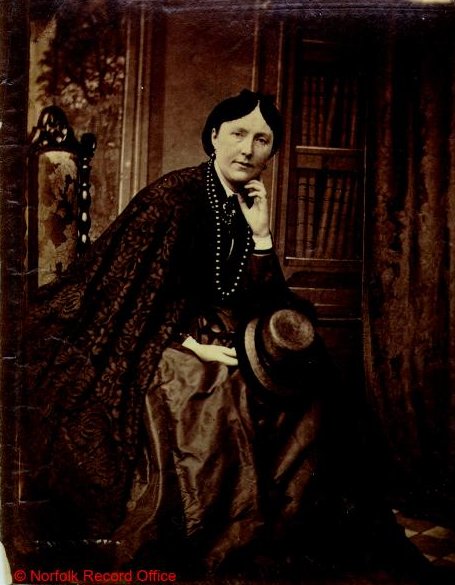
Norfolk Agricultural Show 1906: - This year brought great sadness when Mary Anne passed away at the age of 76. She died on May 12th, her remains were laid to rest in the mausoleum at Heydon, where other member of the Bulwer family are buried. The brass plate on her coffin read "Mary Anne Dering Bulwer, died May 12th 1906." The funeral procession left 'QUEBEC HALL' at 10:15 and slowly wended its way through the beautiful park and grounds. The Washington Hearse drawn by a pair of horses was followed by a carriage containing servants of the household. Gathered in the grounds were many leading gentry and tradesmen of East Dereham. Businesses and households had their blinds down and the flag on the St Nicholas church was at half-mast. Great mention was made in the press to the fact Mary Anne belonged to the old Norfolk family of Lee-Warner and had resided in the Hall all her life ----- William himself was now in ill heath and in 1908 he announced he would not seek re-election to any of his post and committees. 1910: June 14th - William the younger, William Derling Earle Bulwer married Lilian Mary Petrie the daughter of William Witon Petrie, on June 14th, 1910 in the district of Brentford.
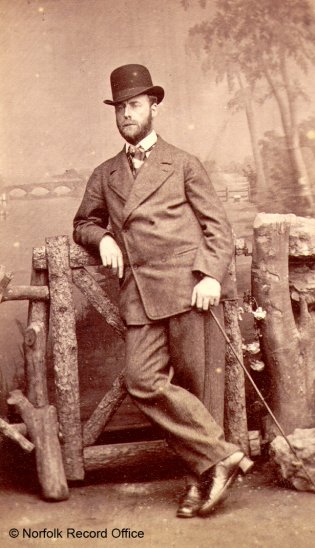
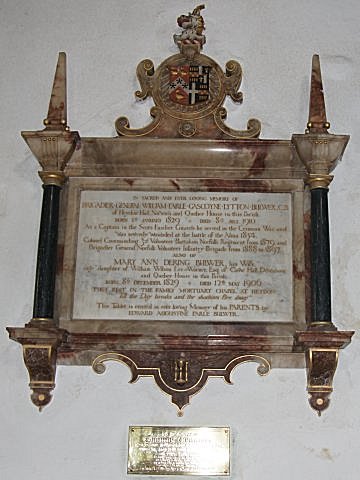
1910: July 8th - William Earle Gascoyne Lytton Bulwer died on July 8th 1910, at QUEBEC HOUSE, age 81. An article in the Army & Navy Gazette reads, he obtained his commission in the Scots Guards, serving with the Regiment during the Crimean War in 1854, including the battle of the Alma, where he was severely wounded (medal with clasp and Turkish medal). Leaving the Army he joined the 15th Norfolk Rifle Volunteers, in February 1861, as Captain. That corps was afterwards merged into the 3rd Norfolk R.V., which he commanded from 1879 to 1894. Colonial Bulwer was also in Command of the Norfolk Volunteer Infantry Brigade from 1888 to 1897, (civil). He was JP for Norfolk and was High Sheriff on the county in 1883. William was laid to rest in the mortuary chapel of Heydon Church with his wife and many of his distinguished ancestors. Like his wife before him his body made the journey from 'QUEBEC HALL' by hearse to Heydon, over the casket was spread the Union Jack, above which rested William's medals. A brass plate bore the inscription "William Earle Cascoyne Lytton Bulwer, General, Born June 1st 1839, Died July 8th 1910." 1911: Jan 28 - Probate; William Earle Gascoyne Lytton Bulwer CB of QUEBEC HOUSE East Dereham Norfolk died July 8th 1910. Probate London to William Dering Earl Bulwer Esquire - Effects £4658. 0s 6d.
1912: Friday July 12th at 3 o'clock
precisely - Auction - At the Kings Arms Hotel, East Dereham.
1914-18: First World War was now in full flow --- How did this effect QUEBEC HALL? ----- There is no record of any Bulwer's killed in action although we know most young men of age took part in some way. We do know of one, the death of Robert Kendall whose father was one of the staff in 1901 - Are there other records? 1915: Sep 8 - The WW1 Zeppelin Raid on Dereham - On the evening of Wednesday September 8th 1915, the L14 Zeppelin appeared over Norfolk, coming in from round the Blakeney area making it's way to Dereham. It is thought the crew had mistaken Dereham for Norwich. They first dropped some bombs over Bylaugh Park where there was a Yeomany Camp, some lights were showing. Several more were dropped on route to Dereham and about 8:50pm one was said to have landed near QUEBEC HALL before finally reaching the town were they dropped the remainder of their load. Much damage was done in and round the market place, four people were killed and seven injured, although two more died later of their injuries - There are several articles and pictures on this subject which can be found on the internet. The two records below give some confusion as
to who lives a QUEBEC HALL during this period. 1914: Eldred Winteringham Wilson - First appears on the Electoral Roll - for QUEBEC HALL in 1914. He also appear on these also, Sheringham (Holway Road), Hillington (Valley Farm), Gaywood (Sea Bank), Bawsey (Land), Flitcham, (Flitcham Abbey amd Harpley Dam) ----- Eldred was born in 1851 and in the 1851 census was named Savill W Wilson he was 4 months old. However, it has to be said there is no official record of his birth or a baptism. He was the son of Rev Plumpton Wilson Clergyman and Vicar of Thorpe Arnold Leicestershire and his wife Margaretta Wilson formerly Margetts - in the 1891 census Eldred was farming and living at Chilver House, Leziate (between Gayton and Kings Lynn, Norfolk) with him was his wife Matilda Miriam Gay daughter of Richard Gay, a Farmer. They had married on July 29th 1874 at North Wotton, Norfolk. Going back ten years In 1880 Eldred and Matilda were living in Ivy, Albemarle, Virginia, America, where Eldred was recorded in the American census as a Farmer. From this census it confirms, after thier marriage, Eldred and Matilda had moved to america we assume in a bid to settle as farmers. We also find their oldest son Richard and daughter Louisa had both been born in Virginia. On further investigation it is found Eldred's eldest sister Agnes had married the Rev John Albert Greaves in 1857 and shortly after their marriage had gone firstly to NSW Australia where some of their children were born and then to Ivy, Virginia, America. We assume Eldred and Margaretts had stayed with them. More below:
In 1891 Eldred and Margaretts (known as Martilda) were at Chilver House, Brow of the Hill, Leziate, Freebridge Lynn, Norfolk, with them were their daughter Louisa, age 15, born Virginia and three other children Mary Ann M, age 8, Clifford E, age 7 and Rachel P, age 3, born at Norfolk England ----- The family then move back to the Kings Lynn area. In the 1911 census his home address was Flitcham Abbey, Kings Lynn, with him was Matilda, his daughter and two servant, he also stated he was deaf. However according to the Electoral Roll Eldred makes and apperance in 1914 ---- Eldred seemed to have had a few issues with his driving for in the April of 1936 he had his licence suspended for driving without Due-Care-and-Attention in Dereham market place, Charles Temple, a Dereham traveller; said he was driving his car through Dereham Market Place towards High Street when Wilson's car came straight across the road from the Market Place and collided with him. Wilson's car went zigzagging along the road for about 30yds. Mr Allwood, addressing the magistrates said that Wilson was a careful driver and had driven over 50,000 miles during the war, (this is interesting as Eldred would have been 63 at the start of the war??). He was fined £2, and his licence suspended for one month. A few weeks later he had a fine of 10s in the August, for going through a red light.
Eldred and Matilda had seven children:
In 1922 Eldred's nephew (brother's son) Charles Plumpton Wilson was living at Eckling Grange, Norwich Road, Dereham - Charles was an English amateur footballer who played at wing-half. He made two appearances for England in 1884. He was also capped for the England national rugby union team in 1881, and was one of only three players to be capped for England at both Association football and Rugby football. 1934/5: December 16th - Yarmouth Independent newspaper - "The Norfolk Show to be invited to Dereham in 1935" - Town Meeting Decission - The Town Council held a meeting at the Assembly rooms to consider the arrangments in regards to the show. It was stated that it had been 20 years since the show had been held a Dereham. and that was before the war. The main requiements was a ground of about 40 acres and an adequate water supply. Further headline... 'THE QUEBEC ESTATE', from some remarks by Mr Eldred Wilson it was gathered a 40 acrea field on the QUEBEC ESTATE was likely to be available for the show. - Did it take place there? 1936: December 12th - Eldred Winteringham Wilson Died - he was buried in Flitcham, Cemetery Norfolk (near Sandringham) - 1937: Probate - Eldred Winterinham Willson of Quebec House, East Dereham, Norfolk, who died December 12th 1936. Probate Feb 1st 1937 to Matilda Miriam Wilson and Richard Eldred Wilson and Richard Hugh Stanton Farmers. Effects £116797. 2s. 2d 1939: Matilda Miriam Wilson died on July 3rd 1939 age 88 at East Dereham. She was buried with her husband at Flitcham Cemetery. - In the same place are some of her and Eldred's children --- Josephine Winteringham, died age 23 in November 1914, Rachel Plumpton, died age 27 on December 10th 1914,* Richard Eldred, age 61 on March 8th 1938, all children of Eldred and Martilda. Richard's wife is also there Charlotte Wilson age 92 who died on October 4th 1966 --- Probate to Louisa Margaretta Wilson, spinster and Mary Mildred Stanton (wife of Richard Hugh Stanton). Effects £8019 12s 1d
My family has a link to the hall through living in the farmhouse. My maternal grandmother, Eva Howard, was living in Quebec farm in 1918 with her father Frederick Wicks, husband James Howard and her first 4 children. James Howard was a steward in charge of running the farm for the Wilsons who lived in the hall. They had a further 3 children whilst there including my mother Phyllis. Eva was with Eldred Wilson on a shopping trip when he had his fatal accident. They left the farm in 1947. The farm was used to billet officers during the war and was bombed on more than one occasion. - Gillian McKever 1939-1945: - Second World War
- very little is known of this period -
any help would be gratefully received.
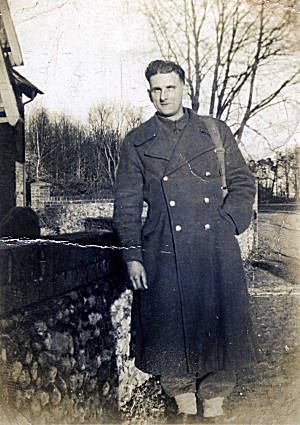
George was born Augustine George Stimpson on August 16th 1915 in the district of Tynemouth, Northumberland, the son of Thomas Soulsby Stimpson, and Elizabeth Kate Dady ---- Elsie was born Elsie Beatrice May Bulluck born August 3rd 1921 at Swanton Novers, Norfolk, daughter of of Arthur John Bullock and Susanna Harriett Sharr ---- George and Elsie had three children all born in the East Dereham district. George spent about 40 years working as a builder for Drew & Son's of Horningtoft, Norfolk As a member of the Norfolk Regiment, George
was first stationed at Britannia Barracks in Norwich with duties
at St Faiths aerodrome. In 1940, he was a member of a group of
about 12 soldiers sent to Dereham to guard what in affect looked
like three haystacks covered by camouflage netting. The containers
were probably made of tin, rectangular in shape about 2ft x 1ft
x 1ft. He was unaware what the material was but in several months
on guard, no stock was received or dispatched from the store.
A guard of two soldiers was on duty 24 hours a day. Most of the
time when not directly on guard they spent their time in a barn
on the farm. A bell tent was provided to shelter them when on
duty. This was replaced by a small Nissan Hut. One evening, having
returned to the barn having completed a spell on duty, George
remembers a large bang. It appears that a bomb landed near the
Nissan hut (just one day after its installation). The blast from
the explosion lifted it into the air and moved it several yards.
One soldier on duty was injured in the thigh. Dr Wilson
was called. He arrived in a dressing gown, performed emergency
first aid and arranged for his transfer to hospital in Norwich.
The soldier suffered some permanent injuries but survived. Bombers
were often seen while on duty. The cook in the Hall was Edna
Hurn and Elsie Bullock was her assistant, they looked
after the soldiers as well as they could and often provided 'unofficial'
meals from the meagre rations - including Christmas Cakes - which
they cut up with their bayonets. Over the year George and Elsie
fell in love, George was constantly in trouble - particularly
for creeping out when he shouldn't. One such event was when he
went to collect the wedding ring from the jewellers in Dereham.
1945: David Charles Carey was the next owner of QUEBEC HALL David and Brigid Carey were occupiers of QUEBEC HALL in 1948 - Brigid died in 2002 at Norwich 1948: Aug 6 - Diss Express -
The Old Buckenham's Young Farmers Club was held at QUEBEC HALL
by kind permission of by Mr D C Carey - Could
be Quebec Farm! 1950's - QUEBEC HALL became a ‘Parents National Education Union’ school ---- We also know that a Miss Tomlin and Miss Hilton had a private school there, as the two eldest daughters of David Potter (builder who bought the property in the late 1950's) attended - no other information at this time - any help would be gratefully received.
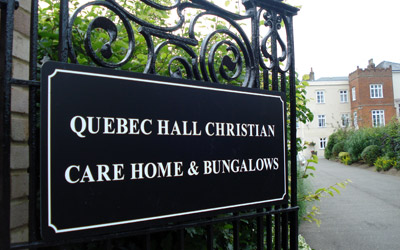
1958/9: QUEBEC HALL was purchased by Dereham builder David Charles Potter ------ QUEBEC HALL had become vacant and was left empty, and falling into decay, like so many large properties after the Second World War. People could not afford the upkeep. David Potter a local builder was on a mission, he had become increasingly frustrated by the fact that Misssionaries and people who had given their lives to doing the Lord's work were, at retirement left homeless. His vision was to create a home and safe haven so they could spend their last years in peace and security.
A note from the late David Potter's
daughters:
David's parents were Charles Robert Potter and Florence Emma Welton, they had married in 1903 at Shelfanger - Florence, David's mother died in 1920, aged just 35. David started work on a building-site and it was not long before he had his own business and men working for him. At the age of 18, in 1932, David was baptised at the Dereham Baptist Church. By 1938 Potter Brothers Builders, Dereham was formed. His first building, the Christian Brethren Gospel Hall, Shipdham Road, Toftwood, was were he regularly worshiped from then to the time of his death. Potter Brothers began in a small way but very soon graduated to public work contacts, and David supervised the building of secondary schools at Fakenham, Wells, Aylsham, Swaffham and Burnham Market. He also built police stations in Dereham, Dersingham, Hunstanton and Downham Market, and the large George Borrow housing estate of Yaxham Road, Dereham. At one time there were over 200 employees. In the June quarter of 1939 he married Brenda Roma Saunders at Dereham, they had two daughters, Margaret and Beryl. They lived at The Beeches, next to Yaxham railway station. After a few years Brenda fell ill and on December 24th 1960 she died age 49. In 1963 he remarried to Bertha Rosalind Horne daughter of Arthur Edward Horne a builder and undertaker of Mattishall and his wife Elsie Kate Fisher, at the Methodist Church in Mattishall. David and Bertha also had two daughters, Rachel and Leah ---- David closed his business in 1979 and retired, but was well known for his hobbies, he had particular affection for wind and steam power, and turned windmills at Saham Toney and Hindolveston into homes. He also restored a mill at his former Yaxham Home. He owned several steam vehicles - and during petrol rationing at the time of the Suez crisis in 1957 he ran a fleet of them ---- On October 31st 1980 David died suddenly at his home, 25 William Cowper Close, Toftwood, Dereham. 1980: Eastern Daily Press - 200 at the Funeral of Mr. David Potter - Toftwood Gospel Hall at Dereham was full for the funeral of Mr. David Charles Potter, formerly one of Norfolk leading builder contractors. Mourners had to be turned away after more than 200 filled the hall and neighbouring schoolroom, to where the service was relayed. Cars lined the main street of Toftwood. Among those paying tribute to Mr. Potter who died at his home in William Cowper Close, Toftwood where former employees of Potter Brothers the building firm he started in 1938 and built up to employ 200 people at one time. The manager, supervisors, office staff and workmen attended the service, which was conducted by Mr. John Smith of Ely. Present Day:
|










|
DOCUMENTS & RECORDS The Norfolk Records Office in Norwich hold a great deal of documents relating to QUEBEC HALL. On doing a search I have found the below - hopefully over time they can be viewed to see if the hold any items of interest to this page. |
||||||||||||||||||||||||||||||||||||||||||||||||||||||||||||||||||||||||||||||||||||||||
|
|
If
you are viewing this site through someone else's browser then
refresh here:- Site Address:- http://www.raytaylor.com |